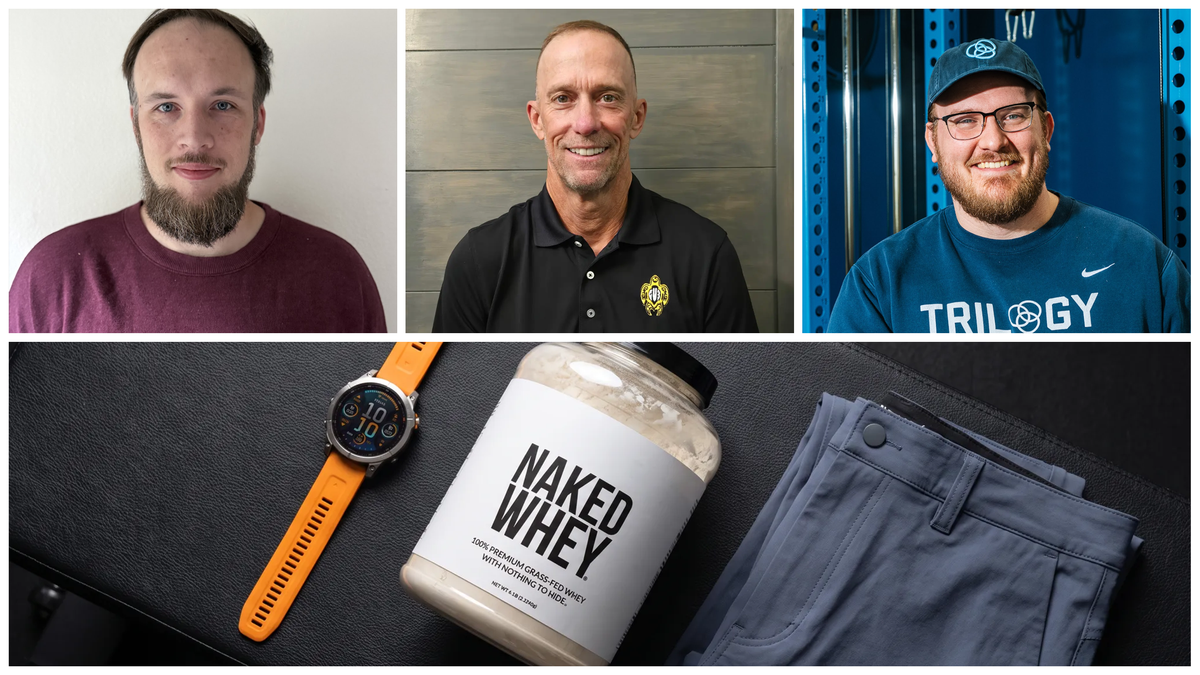

Best for Cooking and Baking: Naked Whey Protein Powder

Best Clear Protein Powder: Clear Whey Isolate

Best Value Protein Powder: Premier Protein
Cart
Your cart is empty

Best for Cooking and Baking: Naked Whey Protein Powder
Best Clear Protein Powder: Clear Whey Isolate
Best Value Protein Powder: Premier Protein

From tracking your workouts to finding gear that holds up and adding more protein to your routine... Read more

Planning family meals can be a challenge when everyone has a different schedule. Pediatric dietit... Read more

Staying hydrated is critical to every part of health and performance. A sports dietetics speciali... Read more

After struggling to find trail runners that felt just right, yoga instructor Emily Hyland landed ... Read more

Best for Cooking and Baking: Naked Whey Protein Powder
Protein powder doesn’t just have to be consumed in shakes or smoothies. There are many practical applications where it can be seamlessly added to doughs to provide you with an extra boost of protein. A defining feature of Naked Whey is that it is flavorless and undetectable in the recipes O’Reilly incorporates it into.
“My favorite choice for [baking] is Naked Whey. This is an unflavored protein and if you look at the ingredients list on the back, there is one ingredient: whey protein concentrate. That's all you're getting,” O’Reilly shares.
“What's great about this brand is they even show you the amino acid breakdown of the protein. So you know you're getting all the essential amino acids that are needed for a complete protein.”
When it comes to cooking and baking applications of protein powder, O’Reilly has a few favorite recipes on hand. “I make protein ‘McGriddles’ and this is what I will use in my pancake batter. It has no chalky taste, it mixes really, really well with just about any liquid. You won't know that it's in there. I've served this to people and I'm like, this is a protein pancake.”
Overall, this protein powder is a bread-and-butter staple for O’Reilly, with variations to make it accessible to many diets and nutritional preferences. “This is a great brand, a great product. I also really like it because there are different variations for people who are vegan, for people who just have lactose issues, or for people who want to go with a soy protein or even an animal-based protein”
Whey-based protein, though, remains his go-to. “But I think for people who can withstand milk, this is a great product if you want just an unflavored additive to your pancake batter, to your banana bread, or just to your morning smoothie so that you can allow the bananas, berries, whatever fruit you pick to really be at the front instead of having to hide behind vanilla or chocolate or what else.”

Best Clear Protein Powder: Clear Whey Isolate
Protein powder takes on many different forms, with new variations seemingly hitting the market all the time. O’Reilly shares that this is one such example, but it lives up to the hype: MyProtein Clear Whey Isolate.
“[This is] something that's a little newer to the market, but I've really been enjoying, and that is clear protein. A lot of the protein powders that people are used to are vanilla, chocolate, strawberry, milky flavors, which can be great. But there are some people who don't like milky flavors,” O’Reilly says.
“MyProtein Clear, this is their blue raspberry. I love blue raspberry flavored anything. I've used this to make my own homemade protein gummies, and they're absolutely delicious. You can also just use it with water, and then it's kind of like juice.”
If your interest was also piqued by protein gummies, O’Reilly adds: “This one in particular, if you're a nineties kid and you remember those Scooby-Doo snacks from back in the day, the blue ones, this is what [Clear Whey Isolate] tastes like.”
“One thing to keep in mind with this product is it is still milk-based; it's from whey protein. So if you do have lactose issues or if you're a plant-based person, you want to look for a plant-based clear protein. It does exist on the market, it's a little more expensive than this product. But it's out there, but for most people I think this is a great pick. It also does boast third-party testing on the bottle, so you know that it's been tested for those foreign substances for any potential problematic compounds or ingredients.”

Best Value Protein Powder: Premier Protein
It’s no secret that protein powder can be more expensive, with the cost only increasing when it comes to ingredient sourcing, availability, and formulation preferences. However, not all are meant to break the bank, and still can help propel you towards your goals.
“Premier Protein—I think a lot of people will have seen this at their big box stores or grocery stores. It is a great value protein product,” says O’Reilly. “If you want something that isn't too pricey, but still has a really good macronutrient profile—and by that I mean the ratio of protein to total calories—Premier Protein for me is the best pick from the mainstream brands that you can get out there.”
One flavor he keeps in his regular rotation. “I particularly love their strawberry protein, the ready to drink ones that come in these smaller containers. That is something that I will just add to coffee in the morning, honestly, or just take with me on the road as I go to the gym so I can have it as a post-workout snack, “ he shares.
“With brands like Transparent Labs, you're going to pay more because they're able to use cleaner ingredients, minimal ingredients. As you go down in price with something like Premier Protein, you're going to see a few more fillers, a few more perhaps artificial ingredients.” However, O’Reilly shares that the conversation around these particular ingredients may be a bit overhyped, and shouldn’t discount this protein’s availability and usefulness.
“A lot of the hoopla around them is overblown. AAs long as you're using it as a supplement and not your primary source of protein, those additional ingredients are not going to be that much of a problem. But it is just something you need to be aware of as you're shopping for protein.”

Anthony O’Reilly is a certified nutrition coach, personal trainer, and former professional supplement tester. He’s previously worked for Muscle & Fitness, BarBend, and Garage Gym Reviews. He was previously a journalist for newspapers in Queens and Long Island, New York and won awards for coverage of Health, Health Care & Science. After going on his personal wellness journey, Anthony combined his love of writing and curious nature with his newfound passion for fitness and nutrition. He spends most of his free time cooking new recipes or looking for a New York-style bagel that reminds him of home.
Complete proteins are key for overall muscle support. They support healthy muscle function, giving them the fuel they need to operate properly. They aid in recovery, when muscle fibers are broken down and need rebuilding after exercise. Protein also assists with muscle growth, helping muscles build in mass and power output by giving it the chemical building blocks to do so. Complete proteins include leucine, isoleucine, lysine, valine, tryptophan, threonine, histidine, methionine, and phenylalanine.
“We have to remember that protein powder is a supplement, which means that it needs to be supplemental to your regular diet, “ O’Reilly says. “You should not be relying on protein powder to reach your protein goals. That should come from the whole foods that you have during breakfast, lunch, dinner, and snacks.”
“With that said, if you're finding that it's tough to meet your protein goal, and most adults need about one to two grams per kilogram of body weight, you can definitely look at protein powder as a useful tool to help you reach that goal at the end of the day.”
“Most protein powders have anywhere from 20 to 30 grams of protein per scoop, which is an ample serving. That's about as much as you get in a lot of different meals. It's also quick at the end of the day. That's the main benefit. You don't have to sit down, eat with a fork and knife, you know, clean a dish. You're just mixing it up and you can take it in the car with you as you go to work.”
“With vegan proteins, you can really break it down into two categories,” says O’Reilly. “The first is soy. Soy milk is something that's been drunk for centuries. It is a complete protein, one of the few vegan-based protein sources that is a complete protein, meaning it has all of the essential amino acids that we need to obtain through our diet.”
“However, soy is a very common allergen out there. There are a lot of people who cannot process soy. So you will have what is called complementary proteins. And what do I mean by that? So if we look at Transparent Lab's vegan protein, they're using part pea protein isolate and then part rice protein. With pea protein and rice protein, they each have their own amino acid makeup.”
“Each one is not a complete protein, but when you put them together, it's like a protein sandwich. And you have all of the amino acids that you need for it to count as a complete protein,” he adds. “So if you're just looking for a great complete protein that's vegan, soy is a great pick as long as you're not allergic to it and you don't have any digestive issues with taking soy. But if not, you can look for a complementary vegan protein that combines two or more different sources that allow you to have a complete protein.”
There have also been new iterations of protein powders, according to O’Reilly. “In recent years there have been additional animal-based protein sources, so they can get it just from what's called beef isolate. The problem with those, however, is that in my opinion, they do not taste as good. A lot of us here have had milk, we know what milk tastes like. It generally tastes pretty good for those who can process it.”
“The ones that are coming from beef isolate, for example, it's a taste that you really need to get used to. It's not something that I personally enjoy, so I tend to stick with the whey isolate because it is also more research backed than those newer animal-based proteins. Those don't have as much research behind them, so the jury is still out a little bit on whether it's an actual effective protein.”
Third-party testing gives you insight into the formulation and ingredient quality of protein powders, also ensuring you’re not ingesting anything that could have negative health ramifications.
“It goes to one of those things where if you're a general consumer, you want to just look for any kind of third-party testing. Specifically, you want to make sure that those test results are available to you,” says O’Reilly. “I'll go back to Transparent Labs, for example. It is very easy for you to go on their website and to find a third-party test for a particular product. So, you can see the results of that test. They're publicly available, and it's easy for you to find.”
Be very careful about brands making big health claims, but not providing the research, testing, and data to back it up. “If somebody claims that they have third-party party testing but you can't find that test on their website, or if you email their customer service and ask for it and they don't give it to you, that might be a sign,” O’Reilly cautions. “The brands that give it and that it's publicly available, you can feel safer knowing that they are telling you the truth.
Not all certifications have the same testing parameters, and for athletes looking to avoid specific substances, make sure to find the exact third-party organization that conducts the type of testing you’re looking for. “When it comes to sports, again, that is something where you might want to look towards your specific federation,” O’Reilly shares. “There are different certifications that are just for NCAA athletes, that are just for professional athletes. But what you have to be aware of is that these different certifications, they're checking for different things. So one third-party certification might be looking for a particular set of substances or ingredients compared to a different one. So you really want to know what you're looking out for and find a particular certification depending on what product you're looking at.”
If These Walls Could Talk” operates independently and exercises sole editorial discretion in all content decisions. While certain brands, products, or services referenced may have current or prior relationships with our affiliated marketing agency, such relationships do not influence our editorial content. We disclaim any liability for conflicts of interest, omissions, or outcomes arising from reliance on our content. All information is provided for general informational purposes only and should not be relied upon as professional or individualized advice.