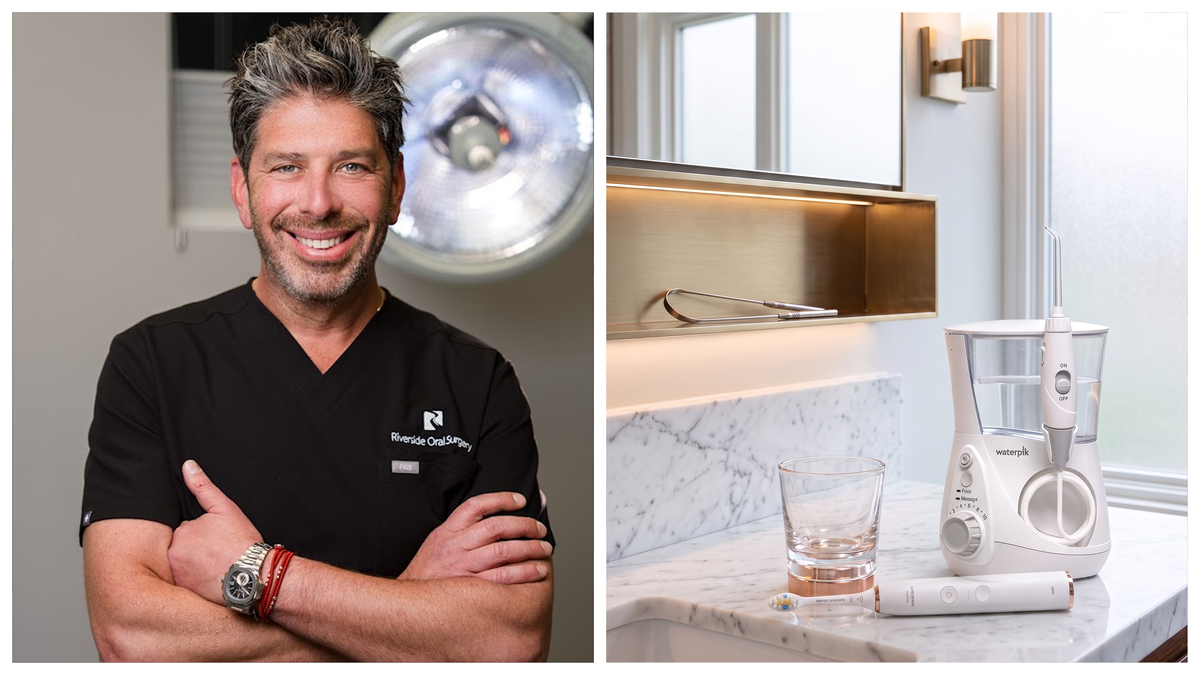
“I think the thing that I would say is the most important and probably overlooked, is a water flosser,” he says. “I feel like the Waterpik, of all the water flossers out there, I find people are most compliant with it. Patients are using it. They use it consistently. They love it.”
He likes it because of the different pressure settings, which are ideal if you’re sharing the device with someone (it comes with individual tips).
“This water flosser works really well because of the multiple settings that it has in terms of pressure,” he says. “Some people have really sensitive gums, some patients have sensitive roots, some patients have very fragile dentistry that needs to be taken care of in a way that is very, very special.”
“If you were to add one thing to your routine tomorrow, the Waterpik would be it.”
Using a water flosser helps you protect soft tissue by gently removing everything that gathers between your teeth and gumline, reducing inflammation along the way.
“The more soft tissue inflammation you have, the more bone loss, the more systemic inflammation you have, and the more problems that are downstream that we see from that,” Auerbach says. “The primary way we do that in the mouth is to keep our soft tissue as healthy as possible. The primary way we do that is by removing as much debris as we possibly can.”
He works his Waterpik in as a final step in his nighttime routine. “I do like to floss first — regular floss — and then I [use the] Sonicare, again for the full two minutes,” he says. “And then I Waterpik, especially around the back, but really all over.”
[Read more: 6 dentists on their favorite water flossers]
At the end of the day, every step in Auerbach’s routine comes back to the same priority: maintaining your oral health.
“Ultimately, if your mouth is healthy, you’re healthy,” Auerbach says. “And that’s kind of it.”